A south-facing wall is the most productive square metre in many small gardens. Trained flat, an apple or pear will crop heavily in less than a metre of border, hide a bin store, and give you blossom in spring and elegant bare branches in winter. The catch is that flat trees are built, not bought. A few decisions in the first two years, then twenty minutes of pinching each summer, and a boundary becomes an orchard. Espaliers and fans are the two classic shapes for the job: the first is formal and horizontal, the second looser and more forgiving of awkward spaces.
Match the tree to the wall
Aspect first. Apples and pears want sun — six hours or more in summer — and the warmth of a wall helps ripen fruit that would struggle out in the open. Plums and cherries crop best in sun too, but they tolerate a little shade, and a fan on an east-facing fence will still give you a respectable bowlful. In cold, exposed gardens, a west wall can work for late-ripening apples, but avoid north-facing spots unless you are growing a cooking apple you plan to store.
Then the rootstock. Choose something that stays small and crops young: M9 or M26 for apples, Quince C for pears, Pixy for plums. A vigorous MM106 or St Julien A will spend its life fighting the wires, and you will spend yours cutting it back. If you garden on shallow chalk or heavy clay, M26 is a good compromise for apples: still manageable, but more tolerant of poorer soil than M9.
Variety matters as much. Espaliers need spur-bearing apples — ‘Egremont Russet’, ‘James Grieve’ and ‘Kidd’s Orange Red’ all train well. Tip-bearers such as ‘Worcester Pearmain’ sulk when pruned hard, though they can be coaxed into a fan. Bramley is a triploid and needs two other apples nearby to pollinate it, while ‘Victoria’ plum looks after itself. For pears, ‘Conference’ is reliable and partly self-fertile; ‘Doyenné du Comice’ crops better with a partner such as ‘Concorde’. Plums like ‘Opal’ and ‘Czar’ are compact enough for fans, and both are self-fertile.
Spacing along the boundary
Measure before you order. Crowding is the commonest reason a run of trained fruit fails: there is simply no light left for the wood that carries next year’s crop.
- Between espaliers: about 3m for apples on M9, 3.5m on M26. Allow for the mature tree, not the maiden you are planting.
- Between fans: 3.5–4.5m, and more on rich ground where plums grow strongly.
- Wires: 30–40cm out from the wall on vine eyes, spaced 30–45cm apart, with the lowest around 45cm above soil level. Use a stouter top wire.
- Planting distance: 30–45cm from the wall. Closer than that and the roots bake in summer while the wall side of the tree dries out.
On a fence rather than a wall, the same spacing applies, but you may need to add a freestanding frame or stout posts if the fence is flimsy. A wooden fence also casts a little shade, so keep the wires slightly further out — 40–50cm — to let air and light reach the back of the tree.
The first year: planting and tying in
Plant bare-root between late November and March, when the soil is workable and not frozen. A maiden whip — a single stem, one year old — is the cheapest and easiest starting point for an espalier or a fan.
- Dig a hole wide enough for the roots to spread, fork the base, and mix in a bucket of garden compost.
- Set the tree so the old soil mark sits at ground level, 30–45cm out from the wall, leaning slightly towards it.
- Cut the whip back to a bud about 40cm above the lowest wire. This is the only hard cut you will make for a while.
- Tie the stem to a cane fixed to the wires with soft twine in a figure of eight, so nothing rubs.
- Water well, then mulch 5–8cm deep, keeping it clear of the trunk.
That summer, shoots will break near the cut. Keep the two strongest, one to each side, and tie them along the lowest wire while they are still pliable. Rub out the rest while they are small enough to flick off with a thumb. Water in dry spells for the first two years; after that, the tree should be finding its own way, though a mulch each spring still pays.
Building the frame
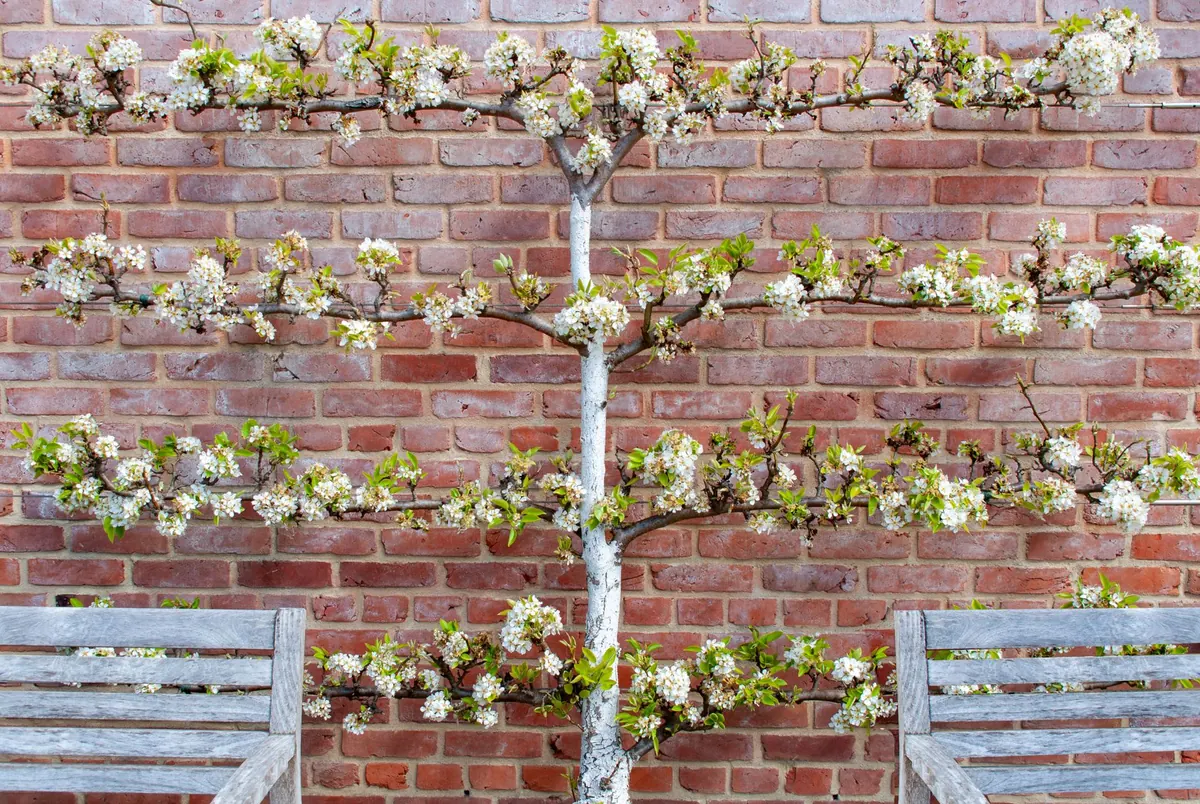
Espalier
An espalier is a ladder of horizontal arms spaced 40–50cm apart. Each winter, shorten the upright leader by about a third, cutting to a bud just above the next wire, which pushes out two shoots to form the next tier. Tie them down as they grow: a shoot trained below horizontal grows more slowly and fruits sooner. Three or four tiers take four to six years, and after that the shape largely looks after itself. When the arms reach their allotted width, cut the tips back to an upward-facing bud to keep the shape neat.
Fan
A fan has no horizontals — five to seven ribs spreading from a short trunk, with side shoots filling the gaps between the wires. It suits plums and cherries, awkward corners, and anywhere you want width rather than height, such as beneath a window. Cut a maiden back to 40–50cm and keep three shoots: one upright, two angled outwards. The next winter, shorten those to encourage branching, and keep tying new growth into the wires, removing anything that pushes straight out into the garden. With plums and cherries, do this pruning in spring or early summer rather than winter to reduce the risk of silver leaf.
Summer pruning: the twenty-minute job
Apples and pears
In late July or August, work along the framework and shorten every side shoot to three or four leaves above the cluster at its base. If a shoot regrows, pinch it back to one leaf. Leave the shoot you are extending to the next wire, and leave the leader tip alone. The shortened spurs ripen, set fruit buds, and next year’s growth starts from the same spot. This is the twenty minutes that keeps an espalier from turning into a thicket.
Plums and cherries
Prune fans of plums and cherries in late June or July, never in winter. Shorten side shoots to about six leaves, then in early September shorten the strongest of those again to three leaves. Remove any shoots growing straight out towards you. Sweet cherries are more demanding than plums; if you want an easier life, choose a self-fertile acid cherry such as ‘Morello’ for a north or east wall, where it will still crop.
Pollination, thinning and aftercare
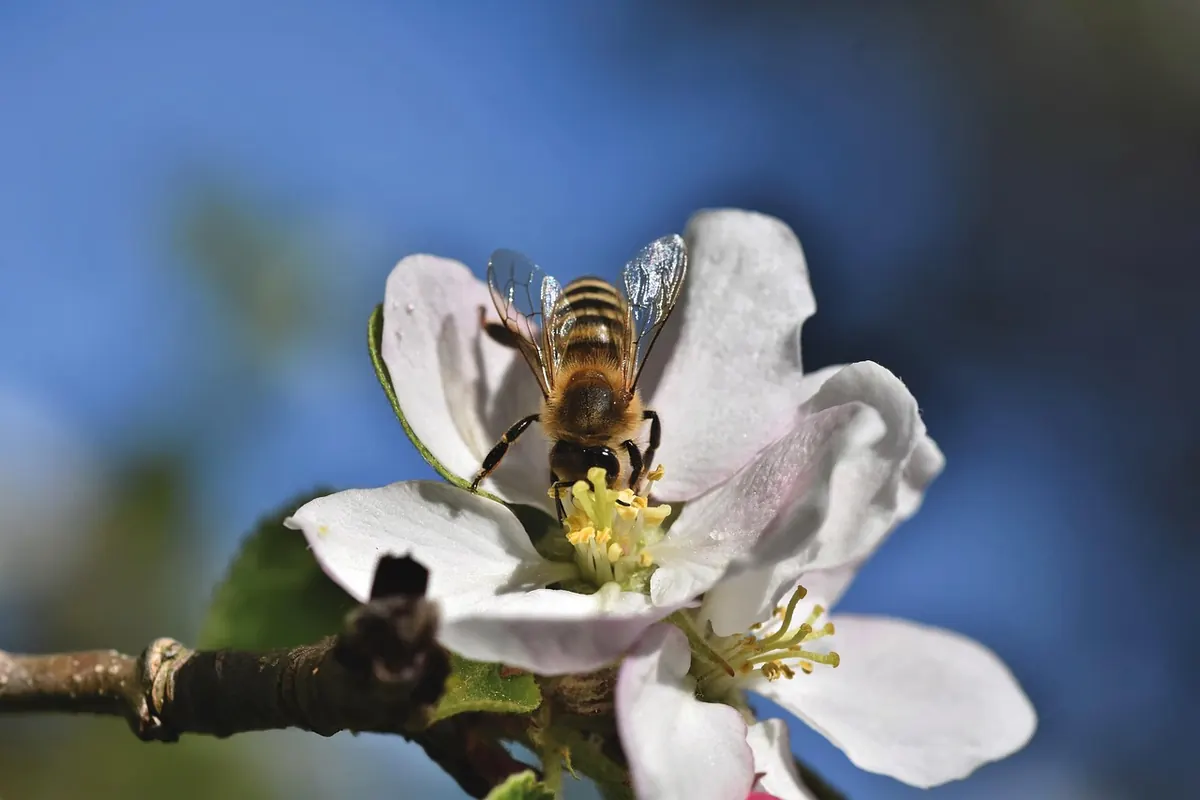
A trained tree has fewer flowers than a free-standing one, so pollination matters more. Check the flowering group of your apple or pear and plant a compatible partner within 20–30m, or choose a self-fertile variety. In a small garden, a neighbouring crab apple or a flowering tree in the next street can be enough, but do not rely on it.
- Thinning: in June, remove crowded fruitlets so apples and pears sit 10–15cm apart, and plums 5–8cm apart. The remaining fruit will be larger and the branches will not snap under the weight.
- Watering: new trees need water in their first two summers. Established trained trees on a wall are surprisingly drought-tolerant, but a long dry spell in July will shrink the crop.
- Feeding: scatter a handful of balanced fertiliser or fish, blood and bone around the root zone in late winter. Do not overfeed: too much nitrogen gives you leaves and shoots, not fruit.
- Netting: birds strip red apples and plums just before they ripen. Drape netting over the tree, or grow a white or green variety that pigeons ignore until later.
Fences, freestanding frames and pots
Not every small garden has a sunny wall. A fan or espalier can be grown against a fence, a shed, or a freestanding frame made from 75mm posts and galvanised wire. On a fence, fix vine eyes into the posts rather than the panels, and keep the wires 40–50cm clear of the wood. If you are renting, or the soil is concrete, grow a dwarf apple or plum in a large pot — at least 45cm across — trained as a fan against a wall. Use a soil-based compost such as John Innes No 3, and feed and water more attentively than you would in the ground.
Common problems and quick fixes
Most trained fruit problems come down to light, pruning timing or water. If the tree makes long, leafy shoots and few flowers, it is too vigorous: reduce feeding, prune less in winter, and summer-prune more diligently. If the centre of an espalier goes bare, tie in a young shoot from lower down to fill the gap, or accept a slightly looser shape. Woolly aphid clusters on apple shoots can be painted with methylated spirits or washed off with a strong jet of water. Brown rot on plums is best prevented by thinning fruit and clearing fallen leaves and mummified fruit from the ground.
One final rule: never let a trained tree carry more fruit than its frame can hold. A handful of perfect apples along each arm is worth more than a heavy crop that breaks the branches and exhausts the tree.
Photo: wal_ 172619 / Pexels