Choosing an apple tree is really two decisions. The first is which apple you want: a crisp Discovery, a sharp Bramley, a russet you can't buy in the shops. The second, and the one that decides how big the tree becomes, how soon it fruits and whether it stays upright in a winter gale, is which rootstock it sits on. The rootstock is the bottom half of the tree — the root system your chosen variety is grafted onto. Get it right and the tree fits the space you have. Get it wrong and you'll spend twenty years pruning something that was never going to behave.
Why the rootstock decides almost everything
Everything above the graft union is the variety: fruit colour, flavour, ripening time. Everything below is the rootstock, and it controls the things you notice every day — eventual height and spread, how quickly the tree settles into cropping, how firmly it anchors itself, and how forgiving it is of thin, dry or heavy soil.
There's a trade-off running through the whole list. Dwarfing rootstocks crop young and stay small, but they need staking, watering and decent soil to do it. Vigorous rootstocks look after themselves and live for decades, but you wait longer for the first proper crop and you need the room to match. So when you see a tree labelled simply 'Katy' or 'Egremont Russet', you're only half informed. Look for the rootstock name on the label.
The dwarfing pair: M27 and M9
M27 — for pots, stepovers and the smallest gardens
M27 is the most dwarfing rootstock in common use. Expect a mature bush of roughly 1.2–1.8m, which makes it the obvious choice for a large patio pot, a stepover along a path, or a fan against a sheltered wall.
The trade-offs are real. M27 has a small, shallow root system, so it needs a permanent stake, a fertile soil and regular watering in dry spells — a container tree may need water most days in summer. It crops young, sometimes in its second or third year, but the crop is modest and the tree is shorter-lived than bigger rootstocks. Don't plant it on poor, sandy or exposed ground and expect it to cope.
M9 — the commercial standard
M9 is the rootstock behind most supermarket apples. It's dwarfing, giving a bush of roughly 1.8–2.4m, and it starts cropping early and heavily — which is exactly why commercial growers use it.
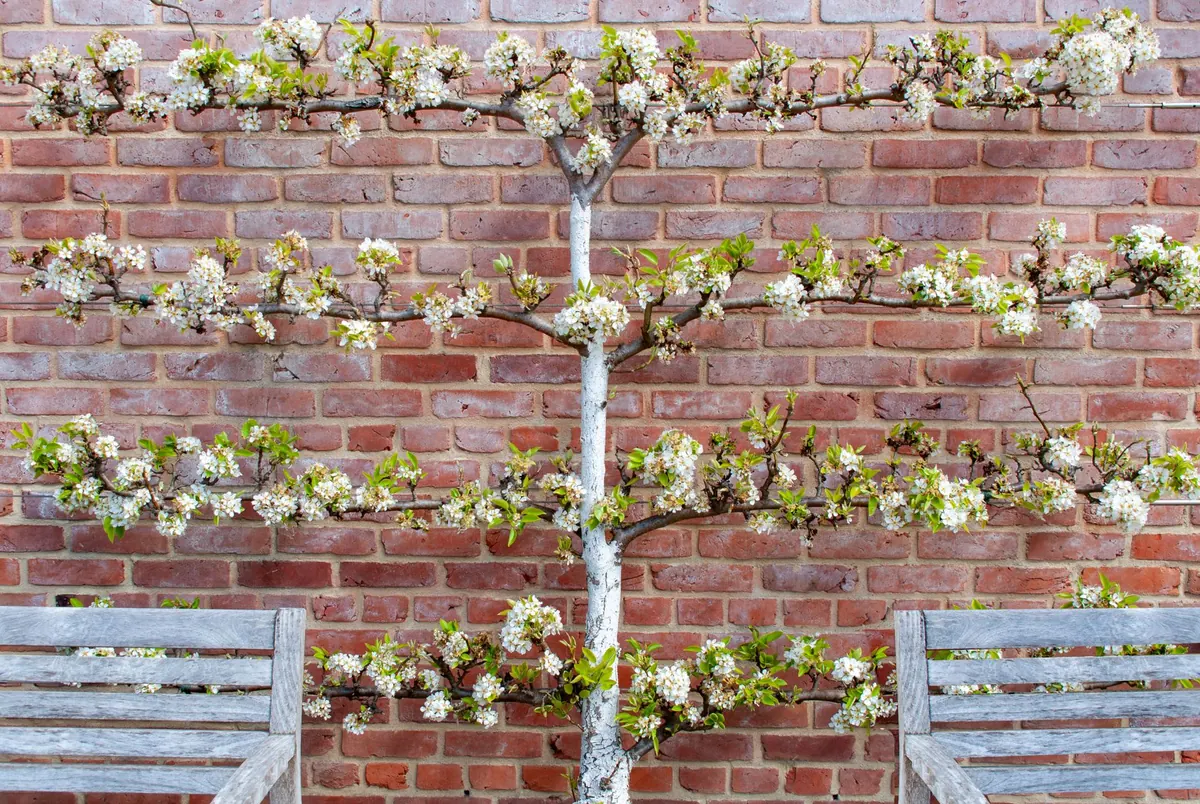
In a garden it's excellent for cordons, espaliers, small bushes and trained forms, and it will grow happily in a large pot for a while. It wants a good, fertile soil that drains but doesn't dry out completely, and it needs staking: permanently on an exposed site, and for at least the first five to eight years anywhere else. M9 dislikes drought and waterlogging in equal measure.
M26 — the middle ground
M26 sits between the dwarfs and the workhorses, and for many gardens it's the sweet spot. A mature bush lands somewhere around 2.4–3m — tall enough to look like a proper tree, small enough to pick from the ground or a low step.
It crops earlier than MM106, usually within three or four years, and it suits cordons, espaliers, fans and small bush trees. Stake it for the first few years and it will usually stand on its own after that in reasonable soil. M26 copes with a wider range of soils than M9, but it still won't thank you for a waterlogged corner. If you want one tree, a decent crop and a manageable size, this is a sensible default.
MM106 — the garden workhorse
MM106 is the rootstock of the traditional garden apple: a semi-vigorous tree of roughly 3–4m, often grown as a half-standard with a clear trunk and a rounded head.
Its strengths are backbone and tolerance. The roots anchor well, so it needs no permanent stake once established, and it copes far better than M9 or M26 with poorer, drier ground and with grass growing close to the trunk. It also shows good resistance to woolly apple aphid. In exchange, it's slower to crop — four to six years is normal — and it takes up more room. Keep a clear circle of bare soil around young trees for the first few seasons, and watch for crown gall on badly drained or previously disturbed ground.
M25 — for real space
M25 is a full-size tree: 4.5–6m or more, the sort you find in old orchards and village gardens, often grown as a standard with a trunk you can walk under.
Once established it looks after itself. It anchors firmly, tolerates a wide range of soils, needs no staking, and lives far longer than any dwarfing tree. The cost is time and space. You'll wait six to eight years or more for a serious crop, you'll need a ladder to pick it, and you'll need 6–8m between trees. It's the right answer for a paddock, a large garden or a traditional orchard, and the wrong answer for almost anything smaller.
The five rootstocks
Photo: kiyu_01 / Pixabay